We value your privacy
We use cookies to enhance your browsing experience, security, and analyse our traffic. By clicking "Accept All", you consent to our use of cookies.
Customise
Decline
Accept All
Led by European Schoolnet on behalf of Video Games Europe, Games in Schools is a project designed to train teachers and educators across Europe on how to use video games as pedagogical support in the classroom.
Following the success of the Games in Schools project in the previous years, Video Games Europe and European Schoolnet continue our collaboration in 2023 to examine the opportunities but also challenges offered by integrating games into our teaching and learning..
The project is based on the results and findings of an earlier project on games in schools, summarised in the Games in Schools report published in 2009.
From 2023-2024, the research was repeated with additions to provide up-to-date insights and evidence on the topic of game-based learning.
After surveying a total of 1,474 teachers in 26 European countries, the findings confirmed that appropriate use of games boosts students’ motivation, supports varied learning styles, and supports learning for students with special needs. The report highlights European best practices for developing game-based learning, offering diverse examples to inspire teachers, educational institutions, and governments.
read the full report here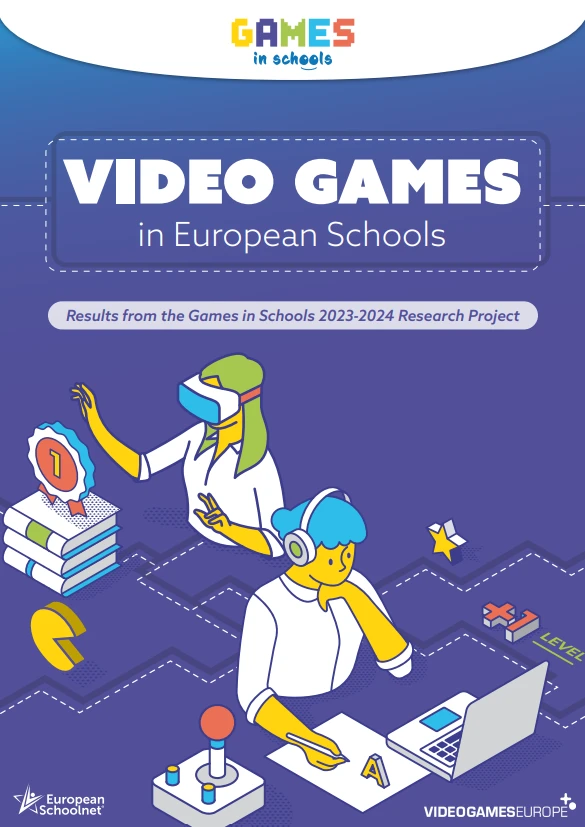
The Games in Schools project started with a 6-week long Massive Online Open Course (MOOC) with the following modules:
The course has been redesigned and all content has been updated from the 2019 edition. The 2023 edition includes a particular focus on topics such as games and inclusive learning and social and emotional learning.
At the end of the course, teachers were asked to come up with tailored lesson plans with game-based learning elements. An Editorial Board of Teachers peer-reviewed the lesson plans and included the best ones in the teacher’s handbook on the use of video games in schools. The course remains free and available for use here.

More than 1,900 teachers from 77 countries registered to take part in the 2023 edition of the Massive Online Open Courses.
99% of the participants rated the overall value of the course as ‘Good’ or ‘Very Good’ and 91% of the participants agreed that they will use the ideas and examples presented in the MOOC in their everyday work.
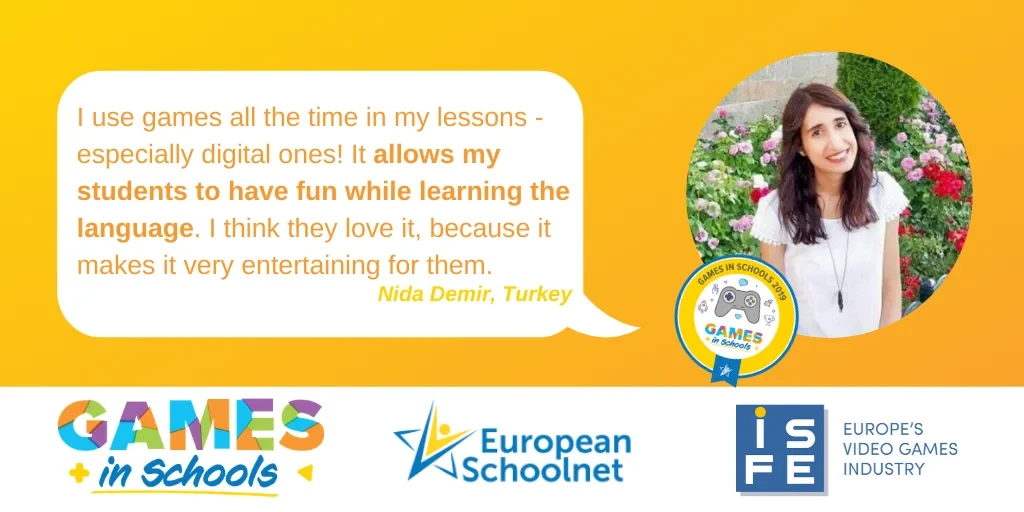
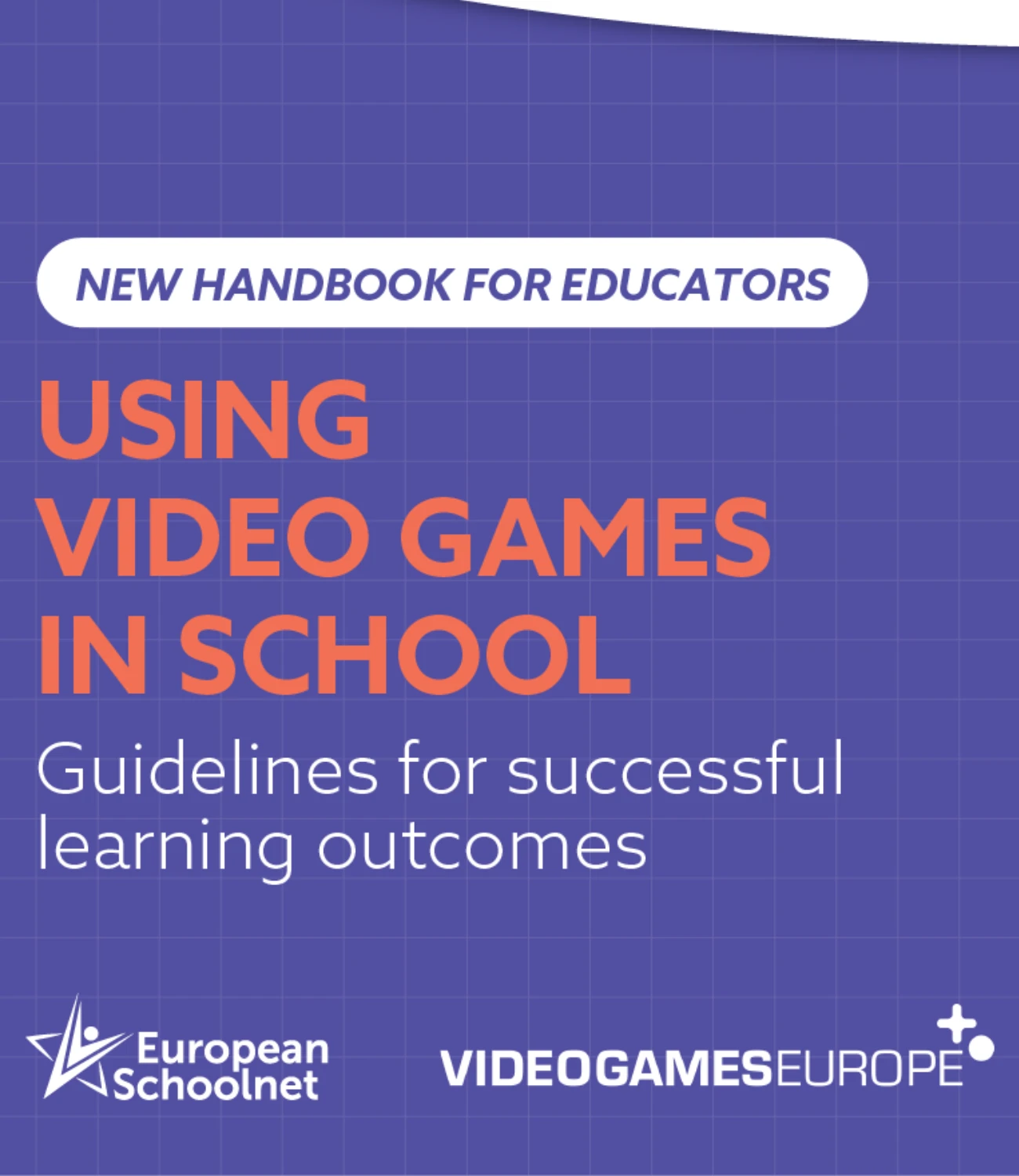
This handbook (updated in September 2023) is intended for teachers interested in using video games in their classrooms. It is a practical guide containing theoretical and practical information as well as references to useful resources such as lesson plans, articles, websites, and books.
The handbook supports teachers to make informed decisions. After reading the handbook, teachers should be able to choose and use video games in the classroom and reaping all the benefits digital games provide.


In its goal to encourage the use of video games for pedagogical purposes, Video Games Europe entrusted European Schoolnet to carry out a study to find out more about how games are effectively and meaningfully used in school education. The study, conducted from Spring 2008 to Spring 2009, draws a picture of the penetration of games in schools across 8 European countries: Austria, Denmark, France, Italy, Lithuania, the Netherlands, Spain (Catalonia) and the United Kingdom. Read or download the report.
Following the study, a six-weeks long MOOC for teachers on how to use games in schools was elaborated. Delivered via the European Schoolnet Academy platform, the course content was coordinated by European Schoolnet with the support of Ollie Bray, an innovative educator and headteacher from Scotland. With an 80% engagement rate and a 39% retention rate, the MOOC provided hugely positive results thanks to hundreds of teachers providing additional data on how games can be used in classrooms. The evaluation report provides important indications on the challenges that teachers face when using games in the class room: Technology and logistical issues were the most common challenges identified by the teachers, spanning from lack of internet access and of devices, to lack rules for the use of students’ own devices and lack of budget.
The Handbook for teachers, written by Dr Patrick Felicia, researcher at the Waterford Institute of Technology in Ireland, is based on the outcome of the MOOC and outlines the necessary information to understand the educational benefits of digital games and to learn how to use them as educational and motivational resources. It allows teachers to make informed decisions on the choice and use of digital games in the classroom. It is available for download here.

Ukie’s Digital Schoolhouse, powered by PlayStation, and sponsored by SEG, Ubisoft and Warwickshire County Council uses play-based learning to engage the next generation of pupils and teachers with the new Computing curriculum (introduced in September 2014). Workshops are hosted by Digital Schoolhouses (usually secondary schools) and taught by their appointed Digital Schoolhouse Lead Teacher (DSLT) to visiting primary schools. The programme ensures its teachers are ever-empowered, confident and inspired to deliver Creative Computing in classrooms across the UK; providing free online adaptable resources, ingenious training and opportunities. All of this is underpinned by academic research and education philosophies.